

1:1 Devices & Education Technology ("EdTech")
More technology in the classroom isn't necessarily better.
Intentional use, not default use.
Schools today are full of screens. Chromebooks, tablets, and an ever-growing catalog of apps and platforms have become standard in most classrooms. But more tech doesn't automatically mean more learning. A growing body of evidence suggests that it can actually negatively impact learning outcomes.
Technology is an important tool, but it should support, not supplant, proven instructional methods centered on human connection and rooted in an understanding of cognitive and social development. It should be thoughtfully and intentionally integrated, rather than by default.
The EdTech Triangle
Think of it like a food pyramid for classroom technology. Not all tech use is equal — some enhances learning, some undermines it.
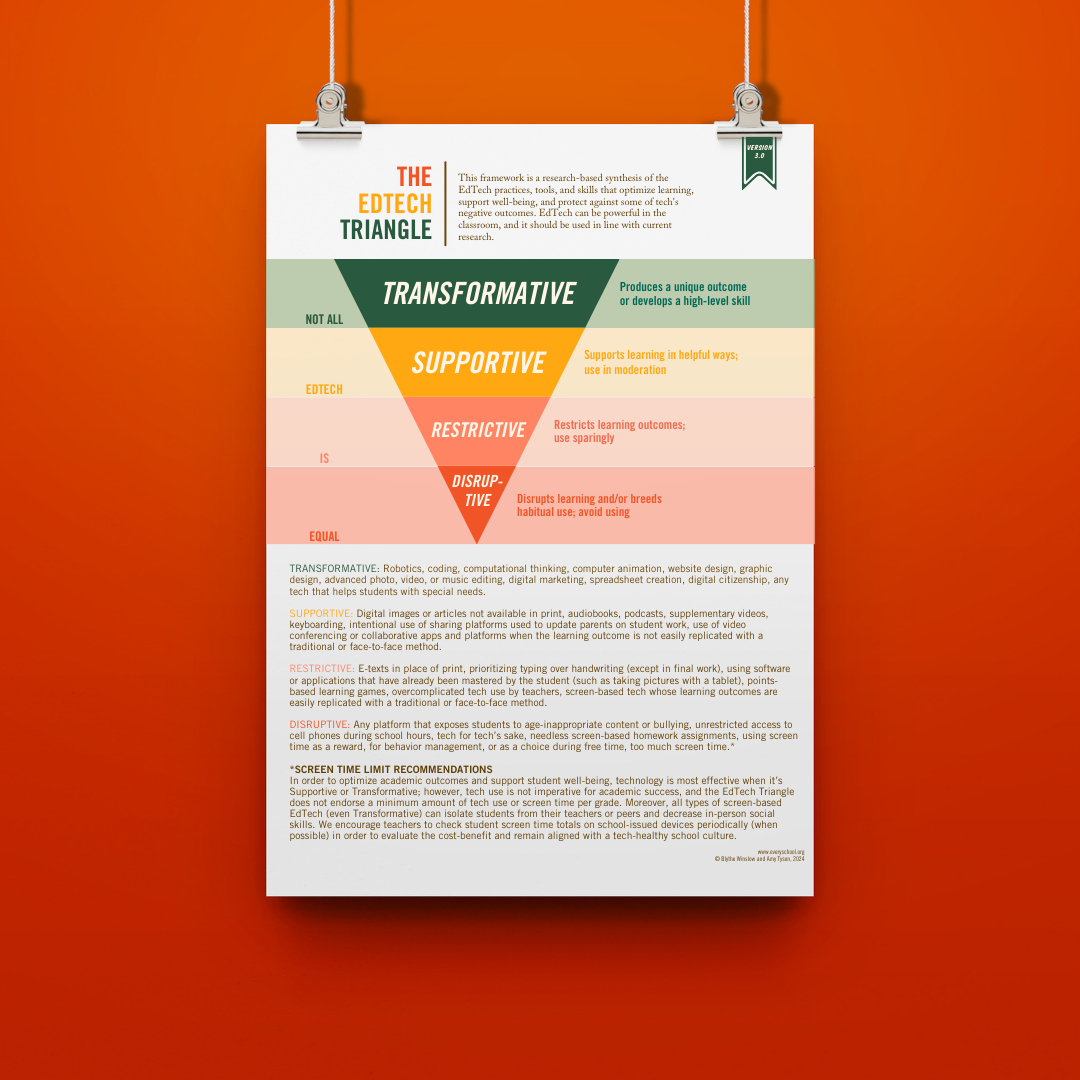
The EdTech Triangle was created by Blythe Winslow and Amy Tyson of Everyschool — the first research-based model of healthy classroom tech use. It's free and open-source for educators and districts.
Transformative
Tech that produces unique outcomes or develops high-level skills that can't be achieved without it — robotics, coding, graphic design, digital citizenship, and assistive technology for students with special needs.
Supportive
Technology that meaningfully enhances learning — audiobooks, podcasts, supplementary videos, and collaborative platforms when the same outcomes can't easily be replicated through traditional methods.
Restrictive
Tech that limits learning potential — e-texts replacing print books, unnecessary screen-based activities with easily replicated outcomes, and points-based games that reward speed over understanding.
Disruptive
Technology that disrupts learning or creates harmful habits — age-inappropriate content exposure, unrestricted cell phone access, excessive screen time, and using tech as a reward or behavior management tool.
The evidence is mounting.
A growing body of research raises serious questions about the increasing role of technology in the classroom:
The OECD's 2024 analysis of PISA data found that student-led use of digital devices in class is negatively associated with performance in reading, math, and science. Students distracted by devices scored significantly lower — even after adjusting for socioeconomic factors.
Students who take notes by hand consistently retain more than those who type, because handwriting engages deeper cognitive processing.
Reading comprehension is measurably higher on paper than on screens, especially for longer or more complex texts.
Questions to ask your school.
You don't need to be a tech expert to ask the right questions. Here are some good places to start:
How many hours per day is my child spending on a screen at school?
What evidence-based research did the school use to determine that using a tablet/laptop for this class is a) developmentally appropriate and b) better than non-digital learning methods?
What problem is this tool solving, and what is the educational rationale for using it?
How is student data being collected, stored, and shared by these tools?
Are there non-digital alternatives being used alongside or instead of screens?
Has the school evaluated whether these tools actually improve learning outcomes?
During school hours, are children allowed to use school-issued devices outside the classroom (e.g., lunch, free time, recess)? Who monitors their use?
How do teachers feel about the amount of screen time in their classrooms?
What to advocate for.
Transparency: Parents should know what tools are being used, how much screen time is involved, and what data is being collected.
Evidence-first adoption: New tech tools should be evaluated for actual learning gains before rollout, not adopted based on vendor pitches.
Parent input: Families should have a seat at the table when technology decisions are made.
Age-appropriate limits: Younger students especially benefit from hands-on, paper-based, and play-oriented learning.
Cumulative screen time awareness: Schools should consider the total screen load on students — school plus home — not just what happens during class.
What your community can do.
Communities across the country are petitioning their school boards for common-sense classroom screen time policies. See what's happening and join the movement.
→ WSSD Community Sign-On LetterSee how families in Wallingford-Swarthmore organized a community sign-on letter calling for intentional technology use in their schools.
→Want to learn more?
Explore PA Unplugged's advocacy guide, share your experience through the parent survey, or connect with other families.